Group Portraits Without the Stiffness
A group photograph feels relaxed when the arrangement has structure that people can inhabit.
Build levels
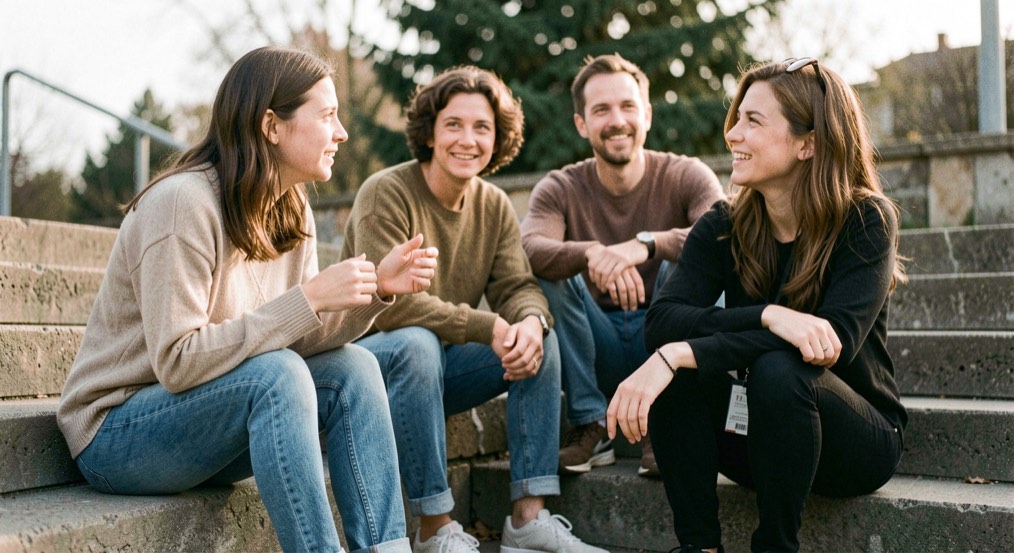
Use steps, chairs, walls or a leaning shoulder to create height changes. A group with one flat eye line often looks formal before anyone has posed.
Give the group a shared task
Ask the people closest together to compare something, tell one short story or look toward a person outside the frame. The small exchange creates connection without requiring a performance.
Shoot the reset
The moment after a formal frame can be the most truthful one. Keep working as people lower their shoulders and talk, while still respecting anyone who wants a pause.
Arrange the relationships
Start by identifying the relationships the group wants remembered. Put the people who naturally speak together within one visual cluster, then create height changes with steps, chairs or a slight lean. Check that heads do not line up like a row of symbols and that hands have somewhere believable to rest. Make the formal frame quickly, then offer a small shared task so the next frames carry the group’s own rhythm.
Groups fail when the photographer solves only the geometry. A beautiful arrangement can still feel cold if everyone is told to smile at the same time. It can also fail technically when a wide aperture leaves one row soft or a fast-moving child disappears from the focus plane. Stop down when the depth of the group requires it, raise ISO if needed, and keep a second arrangement ready rather than forcing one pose past its useful life.
Keep a field record
Take a short break between the formal group and the smaller combinations. People often become more themselves when the camera is no longer asking for one collective expression. Photograph pairs, a parent with a child or the people who organised the gathering, then return to the whole group with a new arrangement. This produces variety without inventing drama. It also gives the final set a social map: the large group explains the occasion, and the smaller frames explain why the people were there together.
Know the limit
The bigger the group, the more important the focus plane and the background become. A wide aperture may make the nearest row beautiful and the back row uncertain. A very wide lens can keep everyone in the frame while stretching the people at the edge. Step back when possible, use a calmer focal length and make the arrangement deeper rather than wider. Check the frame at the edges before releasing the group. A relaxed expression cannot repair a person who has been cut in half by the composition.
Example from the field
Example: for a group of six, seat two people, let two lean against the wall and keep two standing behind. Ask the seated pair to compare a detail from the day while the others look toward them. Make the formal frame first, then keep working through the exchange. If the group is too deep for the chosen aperture, raise ISO and stop down. An awkward focus compromise is harder to repair than a little digital noise.